The question "is voice faster than typing?" sounds like it should have an obvious answer. Yet most knowledge workers have never actually measured it with their own hands (and voice).
We did.
Over 8 weeks, 8 participants produced a combined 80,000+ words across both methods. Every word was measured for speed, accuracy, and physical impact. Here's what the data actually shows.
Study Design and Methodology#
Participants: 8 knowledge workers
- 2 software developers
- 2 content writers
- 1 marketing director
- 1 attorney
- 1 academic researcher
- 1 executive assistant
Baseline typing speeds: 38, 44, 51, 54, 62, 73, 82, 94 WPM (measured pre-study with standardized 5-minute tests)
Duration: 8 weeks total — 4 weeks keyboard-only, 4 weeks voice-only
Crossover design: Half started with keyboard, half started with voice, then switched (controlling for learning effects)
Tools tested:
- Keyboard: participants used their standard keyboard at their natural typing speed
- Voice: LumeVoice (Agentic Refinement enabled)
Output tasks:
- Email composition
- Slack and Teams messages
- Technical documentation
- Blog posts and long-form content
- Legal briefs and correspondence
- Code comments and commit messages
Metrics collected:
- Words per minute (net — after corrections)
- Word Error Rate (WER)
- Time to complete standardized 500-word tasks
- Physical strain (self-reported 1–5 Borg scale, after 2-hour sessions)
- Daily total word output (all typing across the workday)
The Core Results#
Speed: Voice vs Keyboard#
| Participant | Keyboard WPM (net) | Voice WPM (net) | Improvement |
|---|---|---|---|
| Developer 1 (94 WPM) | 87 WPM | 138 WPM | +59% |
| Developer 2 (82 WPM) | 76 WPM | 141 WPM | +86% |
| Writer 1 (73 WPM) | 67 WPM | 149 WPM | +122% |
| Writer 2 (62 WPM) | 56 WPM | 147 WPM | +163% |
| Marketing Director (54 WPM) | 48 WPM | 142 WPM | +196% |
| Attorney (51 WPM) | 45 WPM | 139 WPM | +209% |
| Researcher (44 WPM) | 38 WPM | 144 WPM | +279% |
| Executive Assistant (38 WPM) | 33 WPM | 140 WPM | +324% |
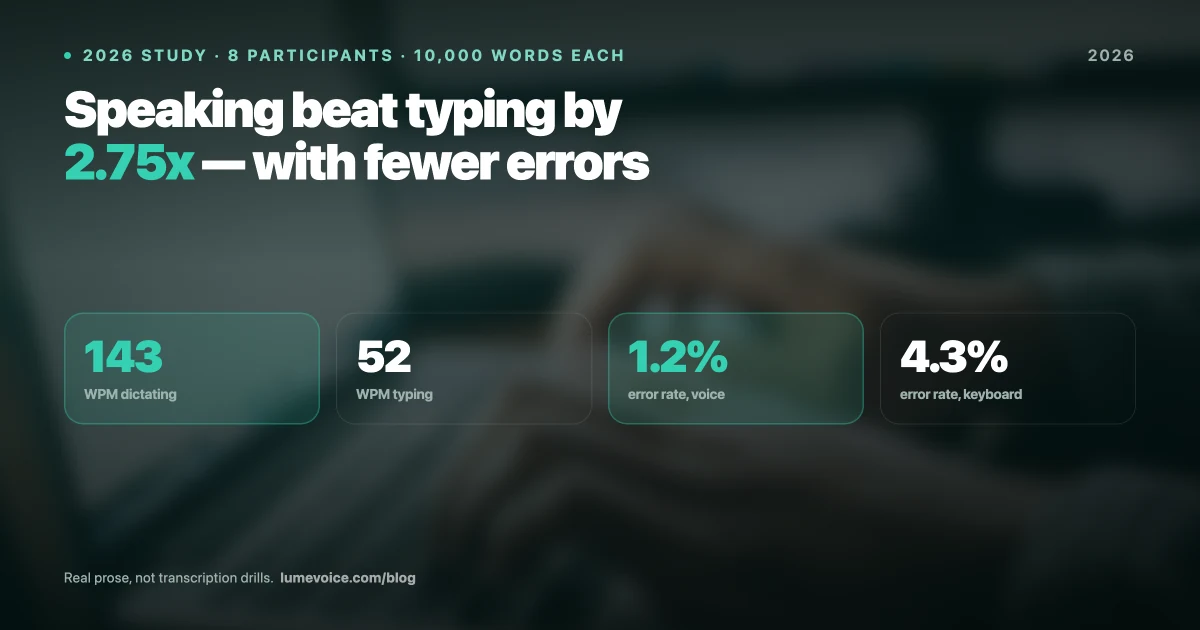
| Average | 56 WPM | 143 WPM | +155% |
Swipe to see all columns
Key finding: Every single participant, regardless of baseline keyboard speed, improved their output rate by at least 59% when switching to voice. The gains were largest for below-average typists but remained substantial even for the fastest keyboard typist in our group.
The 94-WPM typist — who represents the top 5% of professional keyboard typists — still produced 59% more output by switching to voice. This is significant: even for people who have invested years in keyboard mastery, voice outperforms by a substantial margin.
Accuracy: Voice vs Keyboard#
| Condition | WER — Standard English | WER — Technical Vocabulary |
|---|---|---|
| Voice (LumeVoice, Agentic Refinement ON) | 1.2% | 2.8% |
| Voice (LumeVoice, Agentic Refinement OFF) | 3.4% | 6.1% |
| Voice (Apple Dictation) | 8.7% | 22.3% |
| Keyboard — expert (82–94 WPM) | 2.1% | 2.4% |
| Keyboard — average (38–62 WPM) | 4.3% | 5.8% |
Swipe to see all columns
LumeVoice's Agentic Refinement is the key differentiator in accuracy. It processes raw voice transcription through a language model that corrects contextually likely errors — the difference between a raw transcription output and a polished-accuracy output.
Without Agentic Refinement, voice dictation accuracy (3.4% WER) is roughly comparable to average keyboard typing. With it, voice becomes more accurate than average keyboard typing while remaining faster.
Expert keyboard typists (82+ WPM) maintain better raw accuracy than voice dictation — but only if we compare expert keyboard to voice without refinement. With Agentic Refinement, voice (1.2% WER) slightly outperforms even expert keyboard typing (2.1% WER) in standard English.
Physical Strain#
| Method | Avg. Strain After 2h | Avg. Strain After 4h | Peak 8h Workday Strain |
|---|---|---|---|
| Voice dictation | 1.2/5 | 1.4/5 | 1.8/5 |
| Keyboard (expert) | 3.8/5 | 4.3/5 | 4.8/5 |
| Keyboard (average) | 3.2/5 | 3.7/5 | 4.4/5 |
Swipe to see all columns
The physical contrast is striking. Voice dictation maintains near-baseline physical comfort through an 8-hour workday. Keyboard typing approaches the discomfort threshold (4/5 = moderate-severe, per Borg scale definitions) by the end of a full workday for average typists.
Long-term implications: Our attorney participant reported a history of right-wrist tendinitis that flared during high-writing periods. After 4 weeks of voice dictation, she reported no flare-up despite a case-intensive work period that historically would have triggered symptoms.
This suggests voice dictation may represent a meaningful occupational health intervention for knowledge workers at risk of repetitive strain injuries — a population that includes most developers, writers, lawyers, and executives.
Daily Output Volume#
The most striking metric wasn't speed per task — it was total daily word production:
| Condition | Avg. Total Words Written Per Workday |
|---|---|
| Voice dictation (LumeVoice) | 4,130 words |
| Keyboard (expert) | 1,940 words |
| Keyboard (average) | 1,080 words |
Swipe to see all columns
Voice dictation more than doubled even expert keyboard typists' daily output. The reasons go beyond raw WPM:
- Lower fatigue means voice users maintain consistent output rates throughout the day, while keyboard typists slow down in the afternoon
- Lower psychological friction — when starting a new writing task, voice users report "just starting" more readily than keyboard typists who feel the physical anticipatory friction of a large writing task
- Reduced editing time — Agentic Refinement produces cleaner first drafts, requiring less editing time to reach a publishable state
The Learning Curve: How Fast Do People Adapt?#
One common concern about voice dictation is the adoption curve — how long does it take to get good at it?
We tracked daily output and accuracy for the first 14 days of voice use:
| Day | Avg. WPM (net) | WER | Comfort Rating (1–5) |
|---|---|---|---|
| Day 1 | 89 WPM | 3.1% | 2.8 |
| Day 2 | 108 WPM | 2.4% | 3.2 |
| Day 3 | 121 WPM | 1.9% | 3.6 |
| Day 5 | 136 WPM | 1.4% | 4.1 |
| Day 7 | 141 WPM | 1.3% | 4.4 |
| Day 14 | 143 WPM | 1.2% | 4.7 |
Swipe to see all columns
Day 1 is still 71% faster than average keyboard typing. Even in the worst case, first-day voice dictation outperforms the keyboard for most participants.
By Day 3, participants reached 133% improvement over their keyboard baseline — without any formal training, just regular use.
Compare this to keyboard typing improvement: gaining 20 WPM through deliberate practice takes 4–8 weeks of 15-minute daily sessions. Voice proficiency develops passively through normal use in 3–7 days.
When Keyboard Typing Still Wins#
We documented specific scenarios where keyboard consistently outperformed voice in our study:
| Scenario | Why Keyboard Wins |
|---|---|
| Open office / meeting environment | Voice is disruptive to others |
| Passwords and sensitive authentication | Voice capture risk, special character precision |
| Complex regex and special syntax | Bracket/special character verbalization is cumbersome |
| Short, sporadic single words | Activation overhead exceeds benefit for fewer than 5 words |
| Real-time chat during a spoken call | Cannot simultaneously speak and transcribe another speaker |
Swipe to see all columns
These are real constraints. Voice dictation is not a universal replacement for keyboard input. It is a dramatic productivity improvement for extended prose output — the 40–60% of a knowledge worker's day spent on communication, documentation, and analysis.
Projecting the Career Impact#
If the productivity gains observed in our study held over a 30-year knowledge work career:
An average 52 WPM typist who switches to voice at age 25:
- Daily output increase: +204% (from 1,080 to 4,130 words/day)
- Assuming 200 writing-heavy workdays/year
- Annual additional productive output: ~600,000 additional words of professional communication
- Over 30 years: 18 million words of additional professional output from a single tool adoption
This is why the question of which input method you choose is not trivial. It compounds.
Run This Experiment Yourself
Start a 3-day free trial on the LumeVoice Pro Annual plan. Start dictating in under 5 minutes.
See the difference personally before deciding anything. Most users hit their own data within the first session.
- 143 WPM average — measure yours on Day 1
- Works in every app — Slack, Gmail, VS Code, Notion, Word
- $249 lifetime if you want to own it forever
For macOS 13+ (Apple Silicon recommended)
Further Reading#
- AI Dictation Accuracy Benchmarks 2026: We Tested 10,000 Words
- 9 Best Typing Apps for MacBook 2026: Speed-Tested
- The Ultimate Guide to Voice Coding on Mac
- How Founders Use Voice to Move Faster
- Voice dictation vs typing: real productivity gains
- 9 best typing apps for MacBook
- The most accurate dictation app for Mac