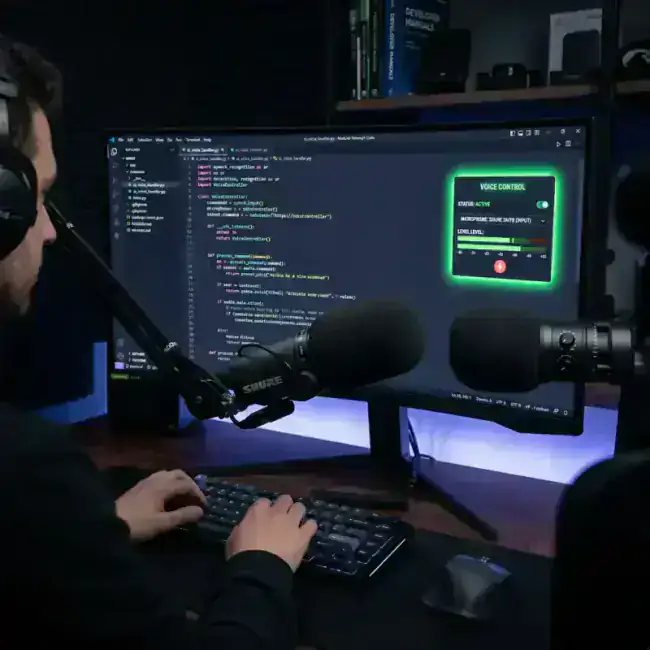
Coding by voice used to be a miserable experience unless you strictly needed it for accessibility. Think clunky commands, wrestling with misheard symbols (curly brace vs brace), and enough latency to ruin your flow. If you could type, you typed.
That's changed. Modern LLMs and context-aware dictation have actually made voice coding viable.
The Syntax Problem
Programming languages don't look or sound like English. You deal with weird casing (CamelCase, snake_case) and endless symbols ((), {}, [], =>).
Old-school dictation just transcribes what you say. Dictating "open parenthesis" 50 times an hour is a surefire way to lose your mind.
AI Actually Fixes This
The new wave of tools doesn't just blindly transcribe. They get your intent.
Instead of barking "const open bracket props close bracket equals arrow function open curly brace", you just talk like a human: "Create a functional component named Button that takes props."
Boom. You get the exact boilerplate you need:
const Button = (props) => {
  return (
    // ...
  );
};
You just saved yourself ten seconds of mindless typing.
Editing With Your Voice
Generating fresh boilerplate is nice, but the real unlock is editing existing code without touching your mouse.
- "Make this function async."
- "Change the color variable on line 15 to red."
- "Drop a console log here to debug the user object."
You say it, and the tool writes the exact syntax change.
Is It Time to Ditch the Keyboard?
If you have RSI or chronic wrist pain, stop reading and switch right now. It's a lifesaver.
If you just want to ship faster, here's the reality:
- Boilerplate & Comments: Voice blows typing out of the water.
- Complex Logic/Refactoring: Voice paired with AI speeds things up significantly.
- Surgical Syntax Edits: Keep your hands on the keyboard.
We're looking at a hybrid workflow. Speak the big ideas and the heavy lifting, then use the keyboard to tweak the fine details.