If you have arthritis in your hands and spend your day at a keyboard, you've probably searched for arthritis hand exercises for typing at some point, usually on a stiff morning or after a long run of emails. Good exercise routines exist, but they come from doctors, therapists and arthritis charities, not from software companies. So this post doesn't invent one. It explains the routine the Arthritis Foundation publishes, how people fit that kind of routine around computer work, and the safety rules that matter.
This isn't medical advice. Exercises suit some joints and not others, so check with your doctor, physiotherapist or a hand therapist before you start, and follow their plan over anything here. Sources were checked as of October 2026.
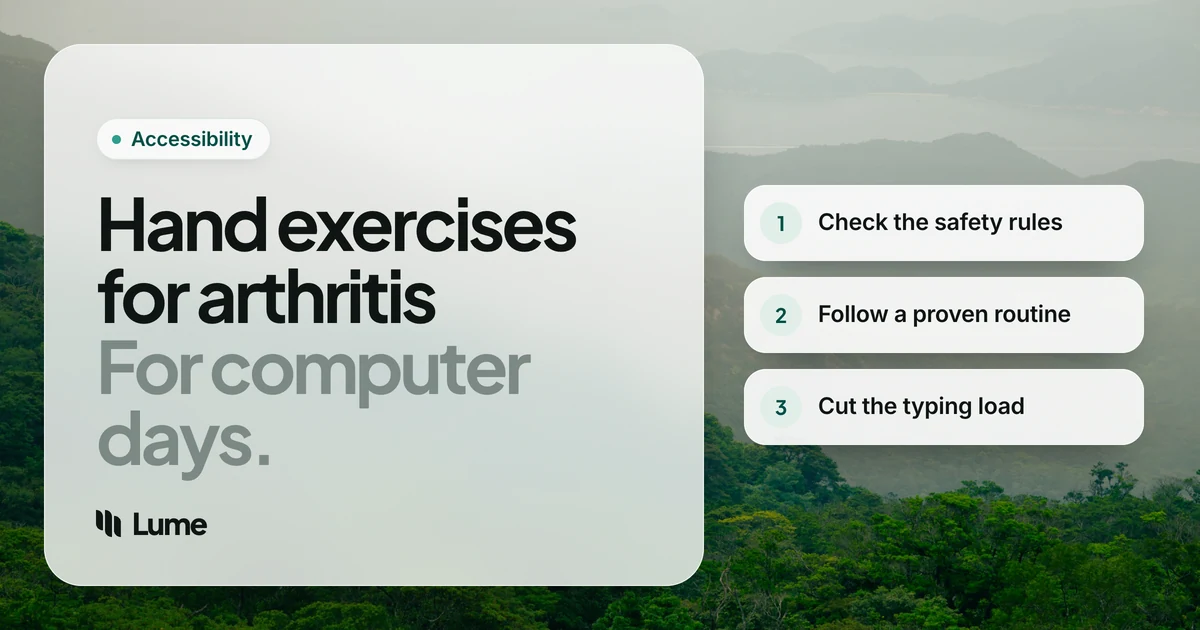
Before you start: the safety rules#
Every reputable source agrees on a few things:
- Get the go-ahead first. Your doctor or a hand therapist knows which joints are affected and how. A routine that suits osteoarthritis at the base of your thumb may not suit rheumatoid arthritis in your knuckles.
- Gentle, slow and pain-free. Move within a comfortable range. Mild stretch is fine; sharp pain is a signal to stop.
- Be careful during flares. The Arthritis Foundation says to avoid squeezing exercises during an acute or active hand flare.
- Consistency beats intensity. The Arthritis Foundation's summary of a 2015 trial in The Lancet notes that people who kept doing their hand exercises did better, and the benefit faded when they stopped.
If your joints are hot, very swollen or newly painful, don't exercise them: call your doctor.
The Arthritis Foundation's nine hand exercises#
The Arthritis Foundation publishes nine exercises and suggests doing them once a day or every other day. Here's what each one involves, in our words. Go to the source for the exact instructions and repetitions, and treat your therapist's version as the one to follow if it differs.
1. Gentle fist#
Start with your fingers straight, then curl them into a loose fist with your thumb on the outside, without squeezing. Open your hand and stretch your fingers straight again. The Foundation suggests 10 per hand.
2. Finger rolls#
Bend the middle and end joints of your fingers first, then the knuckles at the base, so your hand rolls into a fist. Hold for a few seconds and unroll in the reverse order.
3. Finger bends#
With your hand on its side and thumb up, bend your thumb toward your palm and hold briefly, then do the same with each finger in turn.
4. O shape#
Curve your fingers in until your fingertips meet your thumb in an "O", hold for a few seconds, then open.
5. The OK#
With an open hand, touch your thumb tip to each fingertip in turn, opening your hand between each one.
6. Finger lift#
Rest your hand palm down on a table. Lift your thumb off the table and lower it, then each finger one at a time.
7. L shape#
With your hand resting on its little-finger side and thumb pointing up, bend the four fingers in at the knuckles to make an upside-down "L", hold, and straighten.
8. Finger stretch#
Lay your hand flat with fingers together, steadying your wrist with the other hand. Spread your fingers and thumb apart for a few seconds, then bring them back together.
9. Grip strengthener#
Squeeze a soft exercise ball and hold briefly, then let go. This is the one the Foundation says to skip during a flare, because it involves squeezing.
Notice what's missing: there's nothing forceful, no weights and no stretching through pain. That's deliberate.
Does the research back hand exercises?#
For rheumatoid arthritis, a large trial supports a therapist-designed program. The SARAH trial, published in The Lancet in 2015, found that adults with rheumatoid arthritis who added a tailored hand exercise program to usual care had better hand function after a year than those on usual care alone. The program was set up by therapists and adjusted for each person, which is another reason to get yours from a professional rather than a website.
For carpal tunnel syndrome, the picture is different. The NHS says there's limited evidence that hand exercises help, so don't assume an arthritis routine will help with numbness or tingling.
Fitting exercises into a computer day#
The exercises above take a few minutes. The harder part is remembering them when you're deep in work. Ideas that don't require new rules from us, just a bit of planning:
- Attach them to breaks you already take. After a meeting, while a file uploads, before lunch. Mayo Clinic suggests short, frequent breaks from repetitive hand tasks and changing tasks when you can (Mayo Clinic).
- Put them where you'll see them. A sticky note with the names of the exercises your therapist chose is enough.
- Do the right amount. More isn't better. Stick to the repetitions and frequency you were given.
Questions to bring to your hand therapist#
A short appointment goes further if you arrive with specific questions:
- Which of the Arthritis Foundation exercises suit my joints, and which should I skip?
- How many repetitions, and how often?
- What should I do differently on a flare day?
- Is there anything I should avoid at the keyboard or on my phone?
- Would a splint, a different keyboard or other equipment help me at work?
Keeping a simple log helps too: which exercises you did, how your hands felt that day, and how much you typed. Patterns are easier for a professional to spot on paper than from memory.
Cut the typing load, too#
Exercises help your hands cope with the work; the other half is reducing the work. Small changes add up:
- Set up the desk. Keyboard at or just below elbow height, wrists straight, shoulders relaxed (Mayo Clinic office ergonomics). Our typing with arthritis guide covers keyboards, aids and built-in settings.
- Stop pressing two keys at once. Sticky Keys on Mac and Windows lets you press shortcuts one key at a time.
- Speak the long writing. The Arthritis Foundation lists voice recognition software among the ways to adapt your workplace. Dictation doesn't treat arthritis, but it can reduce how much you type. Apple Dictation, Windows voice typing (Windows key + H) and Gboard voice typing are free and built in.
LumeVoice is our dictation app, so take this with that in mind. It works on Mac, Windows, iPhone and Android and cleans up as you talk: filler words go, punctuation goes in, and "at three, actually four" becomes "at four". On a computer you double-press the shortcut (fn on a Mac, Ctrl + Win on Windows) to talk without holding a key, and press once to finish. On your phone, it's a tap. Our arthritis setup guide explains the details.
Rest Your Hands Between Sets
LumeVoice lets you write emails, messages and documents by talking, in any app on Mac, Windows, iPhone and Android.
- Clean text: filler words removed, punctuation and paragraphs added for you.
- Little to hold: double-press to start on a computer, press once to stop; tap to start on a phone.
- 50% off Pro for anyone who finds typing hard, no proof needed.
- Try it first: 3,000 free words, no card required.
When to see a doctor or hand therapist#
Exercises are a long-term habit, not a fix for new problems. Book an appointment if:
- Joint pain, swelling or stiffness is new, getting worse, or lasting longer than it used to.
- An exercise causes pain that doesn't settle soon after you stop.
- You notice numbness, tingling, weakness or trouble moving your fingers. Cleveland Clinic advises seeing a provider for these, and for wrist pain that doesn't improve within a few days (Cleveland Clinic).
A hand therapist (an occupational therapist or physiotherapist who specializes in hands) can also suggest splints, joint protection techniques and equipment for your desk.
The accessibility discount#
If arthritis makes typing hard, you can get 50% off LumeVoice Pro. It's trust-based: email hello@lumevoice.com with a one-line request and we'll send a code to use at checkout on Mac or Windows. See the accessibility page for the steps.
The short version#
Get a routine from your doctor or hand therapist, or check the Arthritis Foundation's nine exercises with them first. Do them gently, regularly and never through pain, and skip squeezing during flares. Then lighten the load: a better desk setup, Sticky Keys, and voice for anything longer than a sentence.