Veterinarians write for two audiences at once: the medical record, which has to be precise, and the client, who needs to understand what happens next. Add referral letters, lab submissions, staff rotas and the practice's social media, and the writing follows you home.
Dictation can help, but vets often hear mixed messages about privacy. "HIPAA doesn't apply to animals" is broadly true in the US and also easy to over-read. This guide tries to be precise about what the rules do and don't say, where records should live, and where a general AI dictation app such as LumeVoice, which we make, fits.
What vets write#
Records and client communication:
- SOAP notes and clinical histories.
- Surgical and anesthesia records.
- Discharge instructions and estimates for a named client.
- Referral letters and specialist reports.
- Lab submission forms and controlled-drug records.
- Reminder messages, follow-up calls and emails to clients.
Practice and professional writing:
- Client-education handouts written for everyone: dental care, parasite prevention, what to expect after a spay.
- Website pages, social posts and newsletters.
- Staff training material and protocols.
- Job ads and interview notes about the role (not the candidate's personal details).
- Continuing-education notes, conference abstracts and articles.
- Emails to suppliers, reps and colleagues with no client details.
What the rules do and don't say#
HIPAA. In the US, HIPAA protects individually identifiable human health information held by covered entities. Animal medical records generally aren't covered.
State law. That isn't the end of it. Many US states have laws or board rules on the confidentiality of veterinary records and when they can be shared, and those rules vary. Your state veterinary board is the place to check.
Client data. Every record carries a client: a name, an address, a phone number, payment details, sometimes notes about the household. That's personal information under privacy law in many places, whatever species the patient is.
Professional ethics. Veterinary codes of conduct expect client confidentiality. In the UK, the RCVS Code of Professional Conduct does, and UK data protection law covers client personal data; in the EU, the GDPR applies.
Practice policy. If you work for a group or corporate practice, it will have a policy on which apps may be used with records. That policy wins.
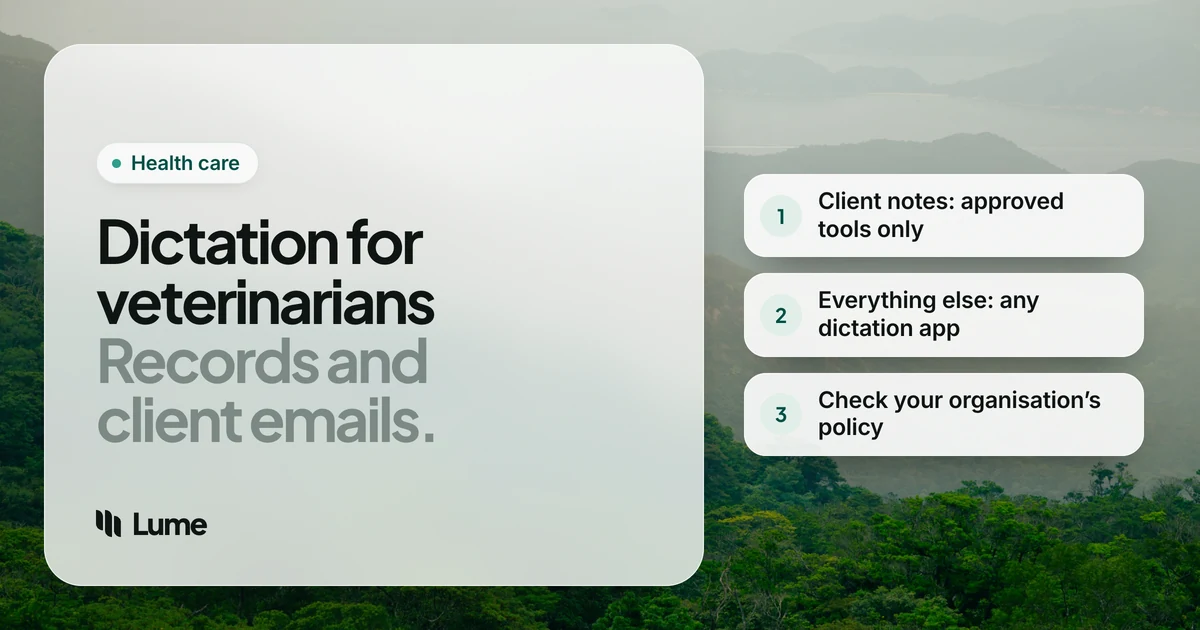
So the precise answer is: HIPAA probably isn't your constraint, but confidentiality still is. Keep medical records and anything that identifies a client in your practice-management software, or in a tool your practice has approved.
This isn't legal or compliance advice. Check your state or national rules and your practice's policy.
Options for records#
Dictation inside your practice-management software. Many veterinary practice-management systems now include dictation or AI note features. If yours does, it keeps the record in one place, attached to the right patient, under the agreement your practice already has with the vendor. Ask your vendor what is stored, where and for how long.
A dedicated veterinary scribe or dictation product. There are several. Treat them like any vendor that holds client data: read the terms, ask where audio and transcripts are kept, check whether it writes into your records system, and get the practice owner's approval.
Dragon Professional on Windows. Not a veterinary product, but some vets use it with a custom vocabulary. As of October 2026, US retailers sell a single Dragon Professional v16 license for about $699, paid once; it runs on Windows only. It's installed on your PC and also controls the computer by voice, which LumeVoice can't do. See Dragon pricing and LumeVoice vs Dragon.
Dictation that runs on your own computer. Superwhisper's local models, MacWhisper and Apple Dictation (in the languages Apple processes on the device) don't send audio to a vendor. If your practice wants dictation with no third party involved, that's the strongest position. Our private dictation guide explains the trade-offs.
Where LumeVoice fits#
LumeVoice is AI dictation for Mac, Windows, iPhone and Android on one plan. Hold fn on a Mac or Ctrl + Win on Windows, talk, and let go: filler words go, self-corrections are applied, punctuation is added and spoken lists become lists, in any app.
It's cloud-based and needs a connection. Audio is sent for processing and isn't stored afterwards, it's never used to train models, and your dictation history stays on your device. It holds no medical or veterinary certification and offers no practice contract or admin console. Even though HIPAA generally doesn't apply to animal records, we don't recommend it for medical records or anything with client details in it. Records belong in your records system.
What's left is a lot of writing that vets often put off because it isn't urgent: the handout you've meant to update for a year, the job ad, the staff protocol, the blog post about summer heatstroke. Explaining it out loud, the way you'd explain it in the consult room, usually gives a clearer first draft than staring at a blank page.
Examples (no client details)#
Illustrative only. They show what the cleanup does, not a measured result.
The client-education handout#
Write it for every owner, not for one. Open Google Docs or Word.
You say (illustrative): "Caring for your dog after a dental, um, procedure. Offer soft food for the first, uh, two days, actually three days. Call us if you notice, one, bleeding that doesn't stop, two, not eating after 24 hours, three, swelling of the face."
What lands: Caring for your dog after a dental procedure
Offer soft food for the first three days. Call us if you notice:
- Bleeding that doesn't stop
- Not eating after 24 hours
- Swelling of the face
Clinical advice in a handout is still your responsibility, so review it as you would any client material.
The job ad#
You say (illustrative): "We're looking for a, uh, registered veterinary technician to join a friendly four-vet practice. You'll, um, run our dental list two days a week and help us build a nurse clinic. We offer, like, CE allowance and no on-call."
What lands: We're looking for a registered veterinary technician to join a friendly four-vet practice. You'll run our dental list two days a week and help us build a nurse clinic. We offer a CE allowance and no on-call.
The staff email#
You say (illustrative): "Hi all, the new, uh, autoclave is being installed Thursday morning, so surgery starts at 11, not 9. Please move any, you know, early admits to the afternoon list."
What lands: Hi all, the new autoclave is being installed Thursday morning, so surgery starts at 11, not 9. Please move any early admits to the afternoon list.
Write the handout you keep meaning to update
LumeVoice turns speech into clean text in Word, Google Docs, Gmail or any other app on Mac, Windows, iPhone and Android. Keep records in your practice software. Try it with 3,000 free words, no card required.
A fair shortlist#
| You need | Look at |
|---|---|
| Medical records attached to the right patient | Dictation or AI notes in your practice-management software |
| A dedicated veterinary scribe | A vendor your practice has vetted and approved |
| Windows dictation with voice control and a custom vocabulary | Dragon Professional (about $699 once at US retailers) |
| No audio sent to any vendor | Superwhisper's local models, MacWhisper, Apple Dictation where processed on the device |
| Handouts, posts, training, job ads and admin with no client details | LumeVoice, Wispr Flow, or built-in dictation |
Swipe to see all columns
Competitor details as of October 2026, from our Dragon pricing and Wispr Flow pricing guides.
Habits worth building#
Separate the device or the app. If LumeVoice is on your phone, keep client calls and messages in the practice's own system, and use the Lume keyboard for your personal and professional writing only.
Add the vocabulary once. On Mac and Windows, add drug names, breeds and your practice's own terms to the custom dictionary, so handouts and training material come out right.
Use snippets for repeated text. The practice address, opening hours, your out-of-hours provider's number for the website: say a short cue and the full text appears.