Physical therapists, occupational therapists and speech-language pathologists share a problem: the treatment is hands-on, and the documentation is not. Evaluations, daily notes, progress reports, plans of care, discharge summaries. Much of it has to meet payer requirements, and much of it gets written after the last patient has gone.
Dictation can take some of that load. But where you work changes which tools are allowed. A PT in an outpatient clinic, an OT in a hospital, an SLP in a school district and a home health therapist all answer to different rules and different IT departments. We make LumeVoice, a general-purpose dictation app that doesn't belong anywhere near patient notes. This guide is about what does, and where a general app still helps.
What allied health therapists document#
Patient or student records:
- Initial evaluations and re-evaluations.
- Daily treatment notes and flowsheets.
- Progress reports, plans of care and discharge summaries.
- Letters to physicians and referrers, and authorization requests.
- In schools: evaluation reports, IEP goals, service logs and progress updates.
- Home exercise programs written for a particular patient.
Professional and practice writing:
- Generic patient-education handouts and exercise sheets for anyone.
- In-service presentations and staff training.
- Clinical instructor feedback frameworks and student orientation guides (not the student's evaluation).
- Continuing-education notes, journal-club summaries and articles.
- Private-practice marketing: website text, blog posts, referral-partner newsletters.
- Admin email: room bookings, schedules, equipment orders.
The core rule, by setting#
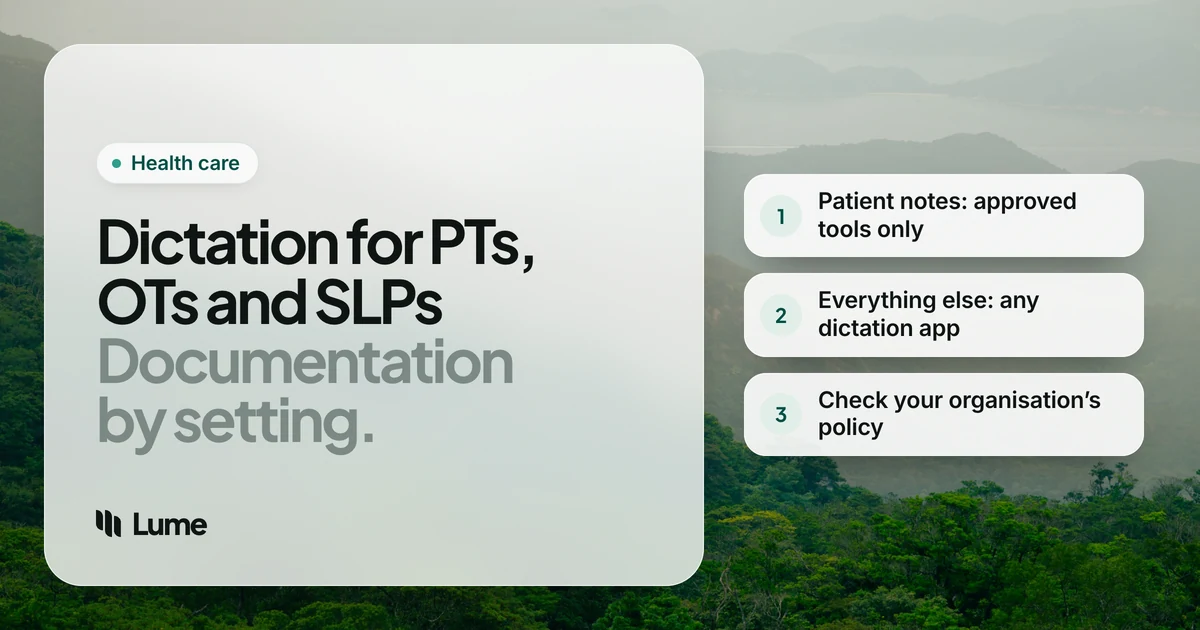
If it identifies a patient or a student, it goes into the system your employer has approved. What sits behind that rule depends on where you work:
- Clinics, hospitals and home health in the US. These are usually HIPAA covered entities. Any vendor that receives protected health information needs a Business Associate Agreement (BAA) with the organization first, and deleting audio afterwards doesn't remove that requirement.
- Public schools. Student therapy records are generally education records under FERPA, with confidentiality rules under IDEA as well. Your district decides which apps may hold them.
- Early intervention and community programs. Funding programs and state rules set their own record requirements. Your agency knows which apply.
- Outside the US. Health data protection law and your regulator (for example, the HCPC in the UK) set the expectations; your employer's information governance policy turns them into rules.
Our guide to private dictation for legal and medical work covers BAAs and on-device processing in more detail.
This isn't legal or compliance advice. Check with your employer, district or compliance office.
Options for documentation#
Dictation inside your documentation system. Many therapy documentation and EHR systems offer speech-to-text, templates or AI note drafting. Ask your vendor or IT team what's available and whether it's covered by your organization's agreement. It's usually the safest route because the note lands where it belongs.
Hospital-wide tools. Therapists in hospitals and health systems may have access to Dragon Medical One, which Microsoft sells to healthcare organizations with integrations for Epic, Oracle Cerner and MEDITECH, or Dragon Copilot, its AI clinical assistant. Microsoft's Dragon Copilot page describes the physician version; ask your organization whether therapy disciplines are included. Both are priced by quote, as of October 2026 (Dragon pricing).
A dictation app with a BAA, for a private practice. Wispr Flow's help center describes signing a BAA in its app's settings on Mac, Windows and iOS, and its Growth plan, at $18 per user per month billed annually, adds org-wide HIPAA enforcement and admin controls, as of October 2026 (pricing details). For a small practice owner, that's one route; your documentation system's own dictation may be simpler.
Dictation that runs on your own computer. Superwhisper's local models, MacWhisper and Apple Dictation (for languages Apple processes on the device) don't send audio to a vendor. Your employer's device and software rules still apply.
Where LumeVoice fits#
LumeVoice is AI dictation for Mac, Windows, iPhone and Android on one plan. Hold fn on a Mac or Ctrl + Win on Windows, talk and let go. On an iPhone, switch to the Lume keyboard; on Android, tap the floating bubble. Filler words go, self-corrections are applied, punctuation is added, and spoken lists turn into numbered lists.
It's cloud-based and needs a connection. Audio is sent for processing and isn't stored afterwards, it's never used to train models, and your dictation history stays on your device. It isn't certified under HIPAA, holds no medical certification and doesn't offer a BAA. It isn't for notes, evaluations, IEP documents or anything that identifies a patient or a student.
What it's good for is the writing that surrounds the job. Many therapists are natural explainers; you spend the day talking people through movements, strategies and exercises. That makes a generic handout or an in-service talk easier to say than to type.
Examples (no patient or student information)#
Illustrative only. They show what the cleanup does, not a measured result.
The generic handout#
Write it for anyone, not for a particular patient. Open Google Docs or Word.
You say (illustrative): "Desk breaks for people who sit all day. Every, uh, 30 minutes, actually every 45 minutes, stand up and do three things. One, shoulder rolls, two, a gentle chin tuck, three, walk to get some water. Um, stop if anything hurts and talk to your therapist."
What lands: Desk breaks for people who sit all day
Every 45 minutes, stand up and do three things:
- Shoulder rolls
- A gentle chin tuck
- Walk to get some water
Stop if anything hurts and talk to your therapist.
Clinical content in a handout is your professional responsibility, so review it as you would any patient material.
The in-service outline#
You say (illustrative): "In-service on safe patient handling, um, for the new nursing staff. Start with why it matters, then, uh, demo the slide sheet, then the stand aid, sorry, the sit-to-stand aid, then questions. Keep it to, like, 30 minutes."
What lands: In-service on safe patient handling for the new nursing staff. Start with why it matters, then demo the slide sheet, then the sit-to-stand aid, then questions. Keep it to 30 minutes.
The school scheduling email#
Keep student names out of it.
You say (illustrative): "Hi Ms. Patel, could I use the small room next to the library on Tuesday and Thursday mornings, um, from next week? I need it from 9 to, uh, 11:30."
What lands: Hi Ms. Patel, could I use the small room next to the library on Tuesday and Thursday mornings from next week? I need it from 9 to 11:30.
For the handouts, talks and emails around the job
LumeVoice turns speech into clean text in Word, Google Docs, Outlook or any other app on Mac, Windows, iPhone and Android. Not for patient or student records. Try it with 3,000 free words, no card required.
A fair shortlist#
| Setting or task | Look at |
|---|---|
| Outpatient, hospital or home health notes | Your documentation system's dictation, or a tool your employer has approved |
| Hospital therapists | Whatever your health system licenses, which may include Dragon Medical One or Dragon Copilot |
| School-based SLPs and OTs | Your district's approved systems for student records |
| Private practice owner choosing a cloud dictation tool | A vendor that signs a BAA, such as Wispr Flow |
| No audio sent to a vendor | Superwhisper's local models, MacWhisper, Apple Dictation where processed on the device |
| Generic handouts, in-services, CE notes, marketing and admin | LumeVoice, Wispr Flow or built-in dictation, where your employer allows |
Swipe to see all columns
Competitor details as of October 2026, from vendor pages cited in our Dragon pricing and Wispr Flow pricing guides. See also LumeVoice vs Dragon.
Practical tips#
Add your discipline's vocabulary. On Mac and Windows, add terms such as goniometry, proprioception, dysphagia or the names of standardized assessments to LumeVoice's custom dictionary, so handouts and talks come out spelled right.
Use snippets for what you repeat. Your clinic's address and parking directions, the link to your exercise video library, your email sign-off.
Keep a clear boundary on your phone. If the Lume keyboard is on your phone, use your employer's app for anything about a visit, and the Lume keyboard only for personal and professional writing.
Therapists who find typing uncomfortable after a day of hands-on work may find dictation helpful for this kind of writing; our RSI page covers lower-strain setups. This isn't medical advice.