"Wait, my Mac can do that?"
Yes — every Mac has had built-in dictation for over a decade, it's free, and most people have never switched it on. This guide covers how to use dictation on Mac properly: turning it on, the shortcut, the commands nobody teaches you, and — just as importantly — the exact point where Apple's version runs out of road.

Worth knowing before you start: a Stanford study found speech input was three times faster than typing in English, with a 20% lower error rate. Most people type around 40 words a minute. Most people talk at 150. That gap is the whole reason to bother.
How to Turn On Dictation on Mac#
Thirty seconds, start to finish:
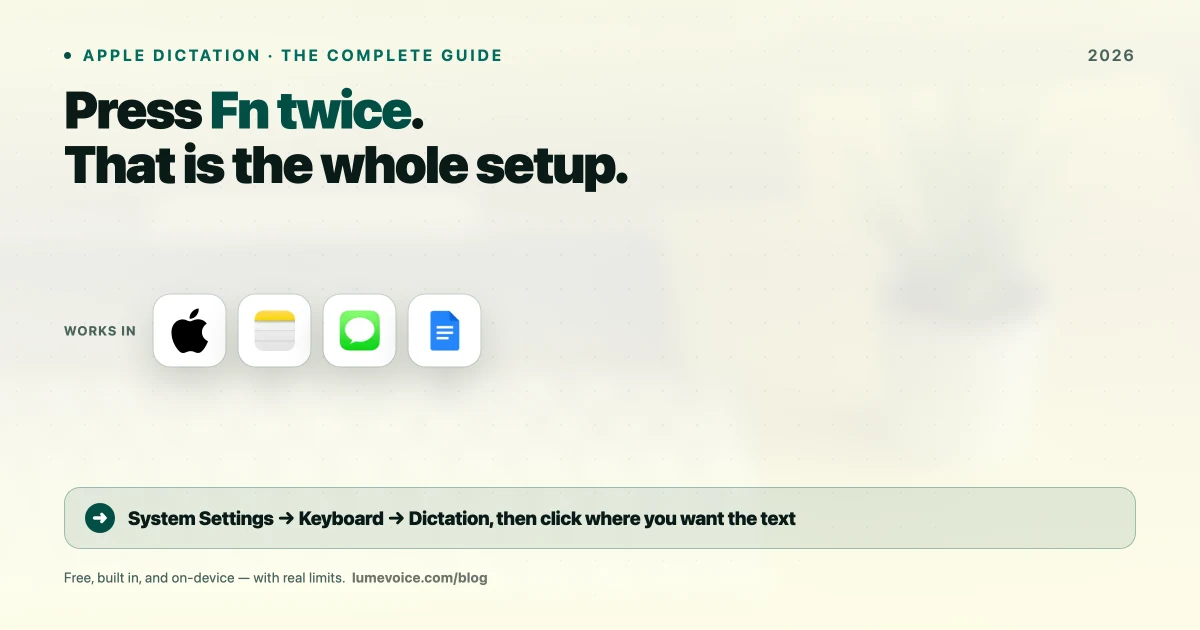
- Click the Apple menu in the top-left corner → System Settings
- Click Keyboard in the sidebar
- Scroll to Dictation and flip the toggle on
- Accept the prompt if macOS asks to enable it
That's the whole setup. While you're on that screen, three settings are worth a look:
- Microphone source — if you have more than one mic, pick the good one. This matters more than any other setting on the page.
- Auto-punctuation — leave this on. It inserts commas, full stops and question marks from your phrasing so you don't have to say them.
- Languages — click Edit to add every language you dictate in.
Using Mac Dictation: The Shortcut#
Put your cursor where you want the words to land, then trigger dictation:
- Fn (Globe) key twice — the default on most Macs
- The microphone key (F5) — on 2021-and-later MacBooks, one press starts, another stops
- Edit → Start Dictation — from the menu bar, if you'd rather not learn a shortcut
You'll hear a high beep and see a microphone indicator. Start talking. To stop: press Esc, hit the shortcut again, or click the mic icon — you'll hear a lower beep on the way out.
Don't like the default shortcut? In System Settings → Keyboard → Dictation, click the Shortcut dropdown. You can choose to press either Control twice, either Command twice, right Option twice, or hit Customise and set anything you want. If you use dictation more than a few times a day, pick something your hands find without thinking.
Mac Dictation Commands Worth Memorising#
This is the part almost nobody reads, and it's where dictation goes from "party trick" to "actually usable."
Formatting
- "new line" — line break
- "new paragraph" — paragraph break
- "tab key" — next tab stop
Capitalisation
- "caps on" / "caps off" — Title Case for a phrase
- "all caps" — next word in ALL CAPS
- "all caps on" / "all caps off" — a whole phrase in caps
Punctuation — say the mark: "comma", "period" (or "full stop"), "question mark", "exclamation mark", "apostrophe", "open quote" / "close quote", "colon", "hyphen".
Emoji and emoticons — "smiley face" gives you :-), "winky face" gives ;-). In some languages you can say "heart emoji" or "car emoji" and get the real thing.
One caveat: if Auto-punctuation is on, you generally shouldn't dictate punctuation out loud as well — you'll get double marks. Pick one approach. Modern speech models infer punctuation from your rhythm better than you can dictate it, so most people are better off leaving auto-punctuation on and just talking.
🎙️ LumeVoice turns speech into clean text in any Mac app — punctuation, paragraphs and filler words handled for you, no commands to memorise. Try it free →
Where Apple Dictation Runs Out of Road#
Apple Dictation is genuinely good at what it was built for: short messages, quick replies, a Spotlight search, a note. Free, private, on-device on Apple Silicon, zero setup. For a two-line iMessage it's the right tool.
Then you try to write something longer and hit the wall. Four walls, actually:
1. It stops after ~30 seconds. Not 30 seconds of talking — 30 seconds without detected speech. Pause to think about your next sentence and the timer fires mid-thought. There's no setting to extend it. This is by far the most common complaint about Mac dictation and it's unfixable from your side.
2. You can't teach it words. No custom vocabulary, at all. Your company name, your framework, your colleague's name, your industry acronyms — Apple Dictation substitutes the nearest common word every time. kubectl becomes "cube control", forever.
3. It transcribes your mess faithfully. Say "um", it types "um". Say "let's meet Tuesday — no wait, Wednesday", and you get exactly that, including the wrong day. It's a transcriber, not an editor, so you end up cleaning up text you spoke to avoid typing.
4. One language at a time. You can add multiple languages, but you have to switch before you speak. Mid-sentence code-switching — normal for a huge number of bilingual people — isn't supported.
If accuracy specifically is your issue, we wrote a fix-first guide: how to fix poor dictation accuracy on Mac. Several of those fixes work on Apple Dictation without changing anything else.
Habits That Make Dictation Actually Work#
Regardless of which tool you use, these are the things that separate people who dictate daily from people who tried it once:
Speak in complete thoughts. Modern models use surrounding words to disambiguate homophones. Stopping after every three words strips away the context they need — and makes the output worse, not better.
Don't slow down. Slow, over-enunciated speech is harder to transcribe accurately than a normal conversational pace. Talk like you're explaining something to a colleague.
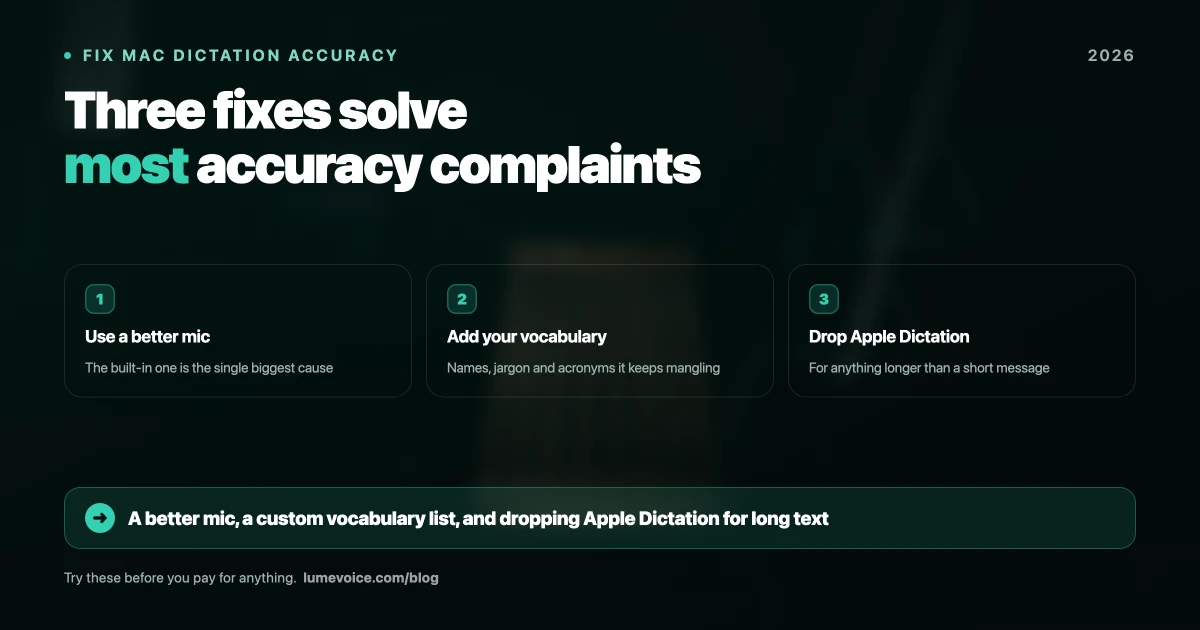
Fix your mic before you fix anything else. The MacBook's built-in mic sits behind the keyboard, pointing away from your mouth, picking up room reflections and fan noise. AirPods beat it. A $40 USB mic beats AirPods. In a hard-surfaced room this one change can halve your error rate.
Dictate the draft, edit with the keyboard. The fastest workflow isn't voice-only. It's talking out the messy first version at 150 wpm, then tightening it by hand. You're trading a blank page for a rough draft, which is the hard part of writing anyway.
Dictation vs Voice Control: Not the Same Thing#
Worth clearing up, because macOS ships both:
- Dictation (System Settings → Keyboard) turns speech into text wherever your cursor is. That's it.
- Voice Control (System Settings → Accessibility) operates the entire Mac by voice — clicking, scrolling, switching apps, opening menus, plus a much deeper set of text-editing commands.
If you want to write faster, you want Dictation. If you need to use your Mac without hands — RSI, injury, permanent accessibility need — Voice Control is the one to learn, and it's far more capable than most people realise.
When to Move Past the Built-In Option#
Stick with Apple Dictation if you're firing off short messages, you want zero setup, and strictly on-device processing matters more to you than anything else. It's free and it's fine.
Look at a dedicated dictation app when any of these are true:
- You're writing more than a paragraph at a time and the 30-second cutoff keeps killing your flow
- You use technical or industry vocabulary that gets mangled every single time
- You want spoken text to come out clean — filler words gone, self-corrections resolved to what you actually meant
- You speak more than one language, sometimes in the same sentence
- English isn't your first language and you want the output to read like fluent written English
That last group is where the difference is biggest. Apple Dictation degrades sharply on accented English; models built for this handle it far better.
LumeVoice was built for exactly that gap. Press a hotkey anywhere on your Mac, talk for as long as you want, and clean text appears in whatever app you're already in — Gmail, Slack, Notion, VS Code, Cursor, Word, Docs. It strips filler words automatically, catches self-corrections and keeps only what you meant, supports 100+ languages including mid-sentence mixing, and learns your custom vocabulary and writing style. Audio is processed in the cloud with zero data retention, never used for training, and your dictation history stays on your device.
For a direct feature-by-feature breakdown, see LumeVoice vs Apple Dictation, or the wider field in the best dictation apps for Mac in 2026.
Conclusion#
Turning on Mac dictation takes thirty seconds: System Settings → Keyboard → Dictation, then Fn twice to start talking. Switch on Auto-punctuation, pick a shortcut your hands like, learn "new paragraph", and use a decent microphone. That alone will get you writing short things noticeably faster than typing.
The honest limit is that Apple built its dictation for messages, not documents. The moment you're drafting emails, docs, code comments or anything with real length, the 30-second cutoff and the missing vocabulary support stop being quirks and start being the reason you give up. That's a tooling problem, not a you problem — and it's worth knowing before you conclude that dictation isn't for you.
Start Writing on Your Mac with Your Voice#
Once you've got the built-in shortcut in your fingers, the next step is text that doesn't need cleaning up afterwards — no 30-second cutoff, no mangled product names, no "um" in your emails.
LumeVoice turns your speech into clean, formatted text in any app on your Mac or Android phone — no retyping, no cleanup. Free to start, no card needed.