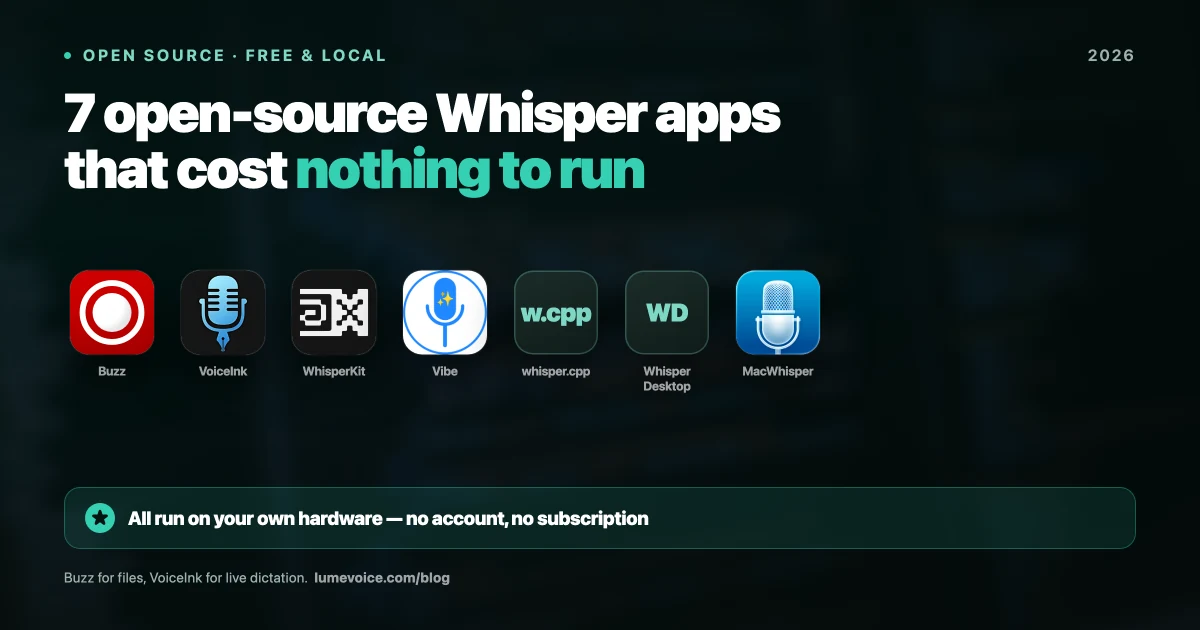
Open-source developers did something genuinely impressive: they took OpenAI's Whisper models and made them run fast on a laptop. You can get high-quality transcription on your Mac, fully offline, for $0.
The tradeoff isn't quality — it's setup time and workflow. Some of these are polished apps; others expect you to be comfortable in a terminal. This guide covers the best open-source Whisper apps for Mac in 2026, what each is genuinely good at, and where the friction actually is.
Quick Comparison#
| Tool | Type | Cost | Best for |
|---|---|---|---|
| Buzz | GUI app | Free (MIT) | File transcription + recording |
| VoiceInk | GUI app | Free from source, $25–$49 one-time | Live dictation into any app |
| whisper.cpp | CLI / library | Free (MIT) | Speed, scripting, pipelines |
| WhisperKit | Swift framework | Free | Building your own Mac/iOS app |
| OpenSuperWhisper | GUI app | Free | Simple menu-bar dictation |
| Ito | GUI app | Free (GPL-3) | No longer actively developed |
| OpenAI Whisper | Python library | Free (MIT) | Custom research pipelines |
Swipe to see all columns
Prices as of October 2026; vendors change them, so check their sites.
1. Buzz — the best free GUI#
If you want a real application rather than a terminal, start here. Buzz is open source (MIT) and free, runs offline on Mac, Windows and Linux, transcribes both imported files and live recordings, and exports to SRT, VTT, and plain text. A separate paid build is sold on the Mac App Store; the GitHub release costs nothing.
- Best for: Podcasters, journalists, students — anyone with audio files and no budget
- Strengths: Genuinely free, no account, subtitle export, cross-platform
- The catch: The interface is functional rather than beautiful, and very long files can be slow depending on model choice
For file transcription specifically, Buzz does most of what people pay for elsewhere.
2. VoiceInk — the best open-source live dictation#
This is the one most "open-source Whisper" lists get wrong: Buzz can't replace your keyboard, and VoiceInk can. It's open source under GPLv3, runs Whisper locally, and types into whatever app you're in.
- Cost: Free if you build from source. Ready-made licences are one-time: $25 Solo (one Mac), $39 Personal (two), $49 Extended (three)
- Best for: People who want local dictation without a subscription
- The catch: Mac only — macOS 14.4 or later on Apple Silicon — and the free path means compiling it yourself
Paying $25–$49 for an open-source app feels odd until you realise you're buying the convenience of a ready-made build, not the code. Against Superwhisper's $249.99 lifetime, it's a strong deal if you're happy with a leaner feature set.
3. whisper.cpp — the engine everything else uses#
whisper.cpp is Georgi Gerganov's MIT-licensed C/C++ implementation of Whisper, with strong Apple Silicon support. Many Mac Whisper apps build on it.
- Best for: Developers scripting batch jobs or building their own tooling
- Strengths: Fast and lightweight, no Python environment, runs on many platforms
- The catch: No interface at all — you're running commands
If you want to transcribe 200 files overnight with a shell script, this is the correct tool.
🎙️ Want dictation without the setup? LumeVoice types clean text into any app and removes filler words automatically. It runs in the cloud rather than on your Mac. Try it free →
4. WhisperKit — for building your own app#
WhisperKit from Argmax is an open-source Swift framework for on-device Whisper transcription on Apple devices, built on Core ML so it can use the Neural Engine.
- Best for: Developers shipping a Mac or iOS app with transcription in it
- The catch: It's a framework, not an app — there's nothing to "use" unless you're writing Swift
5. OpenSuperWhisper — simple local dictation#
An open-source Mac dictation app for people who want something like the Superwhisper experience without the price tag. Simpler and less configurable, but free and local.
- Best for: Basic system-wide dictation with no subscription
- The catch: Fewer features than the commercial options, and as a small community project it's worth checking its GitHub page for recent activity
6. Ito — no longer actively developed#
Ito was an open-source dictation app (GPL-3) with a modern interface. Its repository was reported archived in January 2026, so it's no longer actively developed: don't expect fixes for new macOS releases or new features. If you were considering it, look at Handy (MIT; Mac, Windows and Linux; offline) or Hex (Apple Silicon Macs; offline) instead — both are free and open source, and both type into the app you're using.
7. OpenAI Whisper (Python) — the original#
The official Python library (MIT), released alongside OpenAI's 2022 paper, Robust Speech Recognition via Large-Scale Weak Supervision. It's still the reference implementation and the right choice for research or a custom pipeline.
- Best for: Data scientists and custom processing workflows
- The catch: Needs a Python environment and is far heavier than the C++ ports for everyday use
What Open Source Costs You (It Isn't Money)#
Run locally, Whisper works offline — models download to your Mac once and audio never leaves it. For confidential material that's the strongest privacy position available, which is why open-source Whisper appeals to anyone handling sensitive recordings.
The real costs are elsewhere:
Setup time. Model downloads run from tens of megabytes to several gigabytes. Some tools need Homebrew, Xcode command-line tools, or compiling from source.
Raw output. Open-source Whisper gives you a faithful transcript — false starts, restarted sentences and the sentence you abandoned halfway included. Most of these tools have no cleanup layer. For file transcription that's fine. For live writing, you edit every paragraph.
Limited custom vocabulary. Few of them make it easy to teach the model your product names, your colleagues' names, or your stack — and unusual names and jargon are exactly where speech recognition slips most.
Maintenance is yours. Model updates, macOS breakage, and dependency drift are your problem, and projects can stop, as Ito did.
None of that argues against open source. It argues for being honest about which job you're solving.
Which Should You Pick?#
Transcribing audio files, no budget: Buzz. It does the job and costs nothing.
Live dictation, want to stay local and own it outright: VoiceInk. Build from source free, or pay once for the ready-made build.
Scripting or batch processing: whisper.cpp.
Building software: WhisperKit if you're in Swift, OpenAI's Python library otherwise.
You want to write faster, not administer software: honestly, none of these. Open-source Whisper is excellent at producing accurate transcripts and isn't designed to produce finished writing. If your goal is dictating emails, docs, and messages all day with output you can send without editing, a tool with a cleanup layer will serve you better. That's the gap LumeVoice fills — but it runs in the cloud, so it gives up the offline privacy these tools have. It's a genuinely different job, with a genuinely different tradeoff.
Conclusion#
The open-source Whisper ecosystem on Mac in 2026 is genuinely good. Buzz covers file transcription for free, VoiceInk covers live dictation for a one-time fee or free from source, and whisper.cpp quietly underpins much of what everyone else ships.
Pick based on the job. If you're transcribing recordings, open source isn't a compromise — it's the sensible default. If you're replacing your keyboard, you're trading setup time and manual cleanup for the money you saved, and only you can judge whether that's a good trade.
Skip the Setup, Keep the Speed#
If you tried the open-source route and got tired of editing false starts and filler words out of every paragraph, that's the problem worth solving.
LumeVoice turns your speech into clean text in any app on Mac, Windows, iPhone or Android — filler words removed, self-corrections applied, and a custom dictionary for your names and jargon. It works in the cloud, not offline: audio isn't stored after processing and is never used for training. Start with 3,000 free words, no card required.
Further Reading#
- 9 Best Wispr Flow Alternatives in 2026
- 8 Best MacWhisper Alternatives in 2026
- MacWhisper Review: Is it worth it?
- Best open-source Whisper GUIs for Mac
- MacWhisper vs Buzz vs Whisper Desktop
- The most accurate dictation app for Mac
- Handy alternatives
- LumeVoice vs Handy
- Best VoiceInk Alternatives in 2026: 7 Dictation Apps Compared